Boiled Linseed Oil Still Sticky — Here’s How to Fix It
This article includes affiliate links. We may earn a commission at no extra cost to you.
Having has ruined more than one finishing project chasing a perfect coat, I built up a pretty thorough understanding of boiled linseed oil the hard way. The first real lesson came from a set of cabinet doors I’d spent an entire weekend stripping and sanding down to bare wood. Three days after applying the BLO, the surface still felt exactly like the back of a Post-it note. Turns out I’d made two mistakes at once — which is a special kind of frustrating. If your BLO is still tacky after 24, 48, or even 72 hours, here’s exactly what went wrong and exactly how to pull it back.
Why Your Boiled Linseed Oil Is Still Sticky
Almost every sticky BLO situation comes back to one of three causes. Occasionally, a catastrophic combination of two. Let’s go through them.
You Applied It Too Thick and Didn’t Wipe the Excess
This is probably your problem right now. Boiled linseed oil doesn’t dry the way a solvent-based finish does — there’s no evaporation happening. It cures through oxidation. Oxygen reacts with the oil and slowly polymerizes it into a solid film. But here’s the thing: only the oil in direct contact with air will cure. Whatever sits below that surface layer is sealed off. It stays wet. It stays sticky. Indefinitely.
The correct method is to flood the surface, let it soak in for ten minutes, then wipe off every trace of what didn’t absorb. Every trace. If you can see it, if you can feel it — off it comes. Most beginners, myself absolutely included, assume that leaving more oil on means better protection. It means a sticky disaster. Take it from me.
Cold or Humid Conditions Are Slowing the Cure
BLO needs warmth and dry air. Below 50°F, oxidation slows to a crawl. Above 70% relative humidity, moisture in the air competes with the curing process — and the surface stays tacky for days longer than it should. I once applied BLO in my garage in early November. Temperature was 44°F. I thought it would be fine. It was not fine. The surface was still soft after a full week. Warm conditions and low humidity aren’t suggestions. They’re requirements.
You Accidentally Used Raw Linseed Oil Instead of Boiled
Probably should have opened with this section, honestly — because if this is your situation, none of the other fixes will work until you address it first. Raw linseed oil and boiled linseed oil look nearly identical in the can. Both amber-colored, both smell similar, often stocked side by side on the same hardware store shelf. The difference is that boiled linseed oil contains metallic driers — cobalt or manganese naphthenate — that dramatically speed up curing. Raw linseed oil has none of that. It can take weeks under ideal conditions, months in a cold shop. Check your can. If it reads “Raw Linseed Oil,” “Pure Linseed Oil,” or “Artist’s Linseed Oil,” that’s your culprit.
Fix 1 — Remove the Excess with Mineral Spirits
If you over-applied and caught it within the first 48 to 72 hours, you can often rescue the project without stripping everything down. This is the fix I reach for first — it’s worked on probably six or seven projects over the years.
You probably don’t need anything industrial, you will need a handful of supplies: a can of mineral spirits (I usually grab Klean-Strip from Home Depot, around $12 for a quart), a pad of 0000 steel wool, and some clean rags.
- Pour a small amount of mineral spirits onto the steel wool pad — damp, not dripping.
- Rub the surface in the direction of the wood grain with light, consistent pressure. The mineral spirits will dissolve and lift the uncured excess oil sitting on top.
- Follow immediately with a clean dry rag to wipe up the slurry you’ve created.
- Work in sections. Don’t let the mineral spirits sit and evaporate — keep moving, keep wiping.
- Once you’ve covered the entire surface, let it dry for a full 48 hours before evaluating.
The 0000 steel wool matters. Coarser grades will scratch the wood — the goal here is to buff and lift, not abrade. After the 48-hour wait, run your hand across the surface. Still slightly tacky? Repeat the process once more. Dry and smooth? You’re done. No reapplication needed unless you want another coat for protection — and if you do, apply it thin and wipe it off aggressively.
Fix 2 — Add Heat and Lower Humidity
Frustrated by a slow cure in a cold November garage, I started keeping a cheap space heater near my finishing projects during colder months. Made an immediate difference. If temperature or humidity is your problem, this is your fastest path forward.
Target conditions: above 65°F, below 50% relative humidity. A $30 digital hygrometer from Amazon — I have an Inkbird IBS-TH2 clipped to my workbench — tells you exactly where you stand. Running a dehumidifier alongside a space heater makes a measurable difference in basements and garages. My cure time dropped from four days to under 24 hours once I started doing both together.
For smaller pieces, a hair dryer on low heat held 8 to 10 inches from the surface can help kick-start oxidation. Keep it moving — you’re warming the oil, not baking it. High heat concentrated in one spot causes the surface to wrinkle, which is a whole other problem. Warm the surface for 3 to 5 minutes, let it rest for an hour, check again. For larger panels, a heat gun on its lowest setting works the same way — keep it moving, don’t linger.
Give any heat-assisted cure a full 24 hours at the right temperature and humidity before you call it fixed. Don’t check at the four-hour mark and panic.
Fix 3 — Strip and Start Over with Thinner Coats
Sometimes mineral spirits alone won’t cut it. If the oil has been sitting more than a week and is still tacky — or if you used raw linseed oil by mistake — a full strip is the right call. That’s not what you want to hear, I know. But building over uncured oil costs you more time in the long run, not less.
Turpentine is more aggressive than mineral spirits and works better for full removal. Real turpentine — not turpentine substitute. Sunnyside Pure Gum Spirits Turpentine is what I keep on hand. Soak a rag, work it into the surface, give it two to three minutes to penetrate before wiping. Multiple passes will be necessary.
After the chemical strip, let the wood dry completely — at least 24 hours. Sand back to bare wood with 120-grit, then follow up with 180-grit to clean up the scratch pattern. Wipe off all dust with a tack cloth before the BLO touches the surface again.
When you reapply, use this sequence without exception:
- Apply a liberal wet coat with a brush or rag.
- Wait 10 minutes and let the wood absorb what it can.
- Wipe off every bit of excess with a dry rag — aggressively, until the surface looks almost dry.
- Let it cure 24 hours at room temperature in low humidity before a second coat.
- Repeat the wipe-off step every single time. No exceptions.
Two thin coats done correctly will outperform three thick ones every time. The wood looks better, the finish cures completely, and you don’t end up back here troubleshooting.
How to Apply BLO So It Never Gets Sticky
The principle is simple — flood, wait, wipe. Every sticky BLO surface I’ve ever seen came from skipping or halfheartedly doing the wipe step. That’s what makes the wipe step so endearing to us woodworkers who’ve learned it the hard way: it’s the whole game.
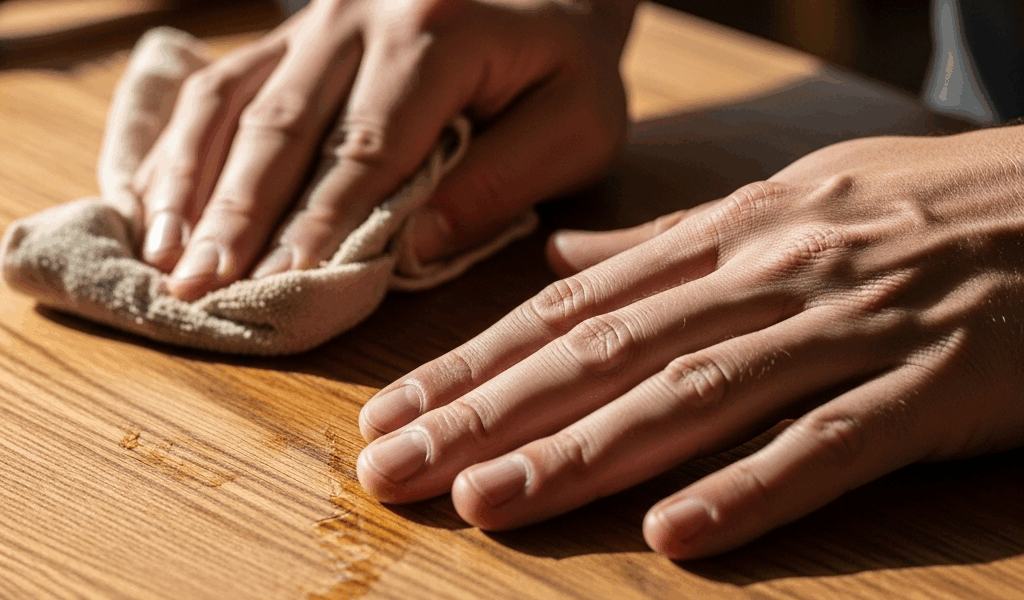
Apply more oil than you think you need. Let it sit for 10 minutes while the wood absorbs what it wants. Then take a clean lint-free rag — I buy Uline shop rags in bulk — and wipe off everything that remains. Not a thin film. Not a sheen. Wipe until the rag comes away almost clean. Done right, the surface will look like barely-oiled wood. That’s correct. That’s exactly what you want.
One more thing — and I’m not burying it at the bottom: BLO-soaked rags are a spontaneous combustion hazard. Not a remote theoretical risk. A real cause of workshop fires. The oxidation that cures the oil generates heat. A crumpled, oil-soaked rag wadded up in a trash can has enough insulation to let that heat build to ignition. Spread used rags flat to dry outdoors, or submerge them in a metal can filled with water and seal the lid. Not once, not ever, wad them up and toss them in the trash.
Sticky BLO is fixable — in most cases, it’s a fast fix. But the best version of this repair is never needing it in the first place.



Stay in the loop
Get the latest craftsman charm updates delivered to your inbox.