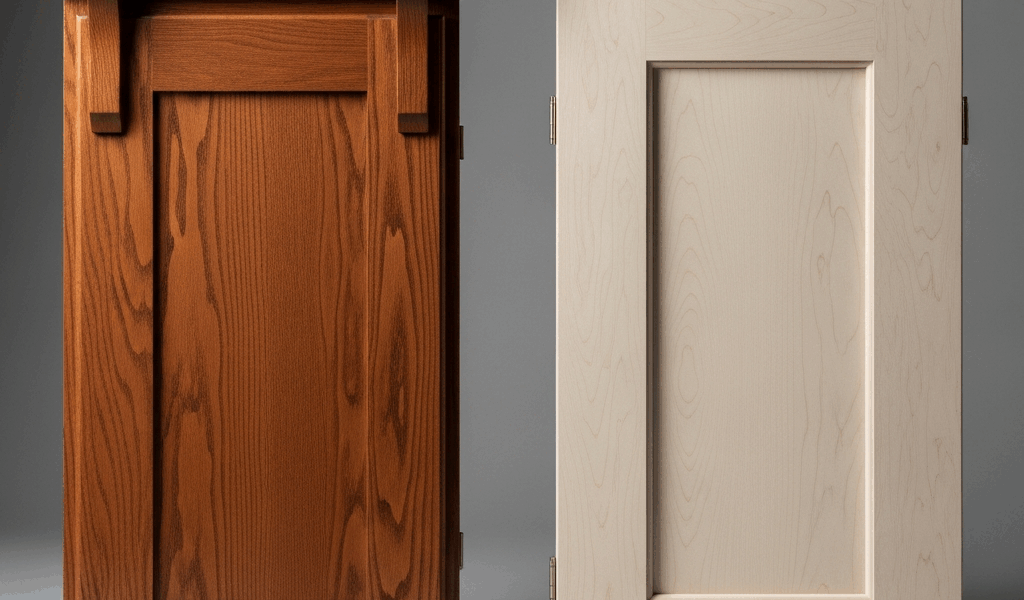
Craftsman vs Shaker Style — The Differences That Actually Matter
Craftsman vs Shaker — Why They Get Mixed Up
Having spent two years speccing furniture for clients, I built up a pretty thorough understanding of confusing these two styles — the hard way. I was deep into planning a built-in bookcase for a living room project, scribbling “Shaker-style” across my notes like I knew what I was talking about, when the cabinetmaker I’d hired — Ron, a guy who’d been running his own shop outside Portland for about 35 years — just stared at me and said, “That’s not Shaker. That’s Craftsman.” Two years of confident mislabeling, gone in one sentence.
This article includes affiliate links. We may earn a commission at no extra cost to you.
The confusion has more noise than signal these days. Both styles reject Victorian ornamentation. Both use flat-panel doors. Both stick to horizontal and vertical lines without much decorative carving to speak of. Drop a Shaker side table and a Craftsman side table at the same estate sale and most people — even people who genuinely care about furniture — land on the same word: “simple.” But the philosophy driving each style is completely different. And that philosophical gap produces real, visible, identifiable differences in the finished piece.
Worth knowing before you buy, build, or spec either one.
The Shaker Style — Simplicity as Spiritual Practice
Shaker furniture is furniture built around a moral position, not a design one. And there’s more depth to it than that simple definition suggests.
Shaker pieces weren’t designed by a firm or a movement of aesthetes. They came from the United Society of Believers in Christ’s Second Appearing — the Shakers — a religious sect that set up communal settlements across New England and the Midwest starting in the late 18th century. Their theology ran straight through into their woodworking: beauty for its own sake was vanity. What served no function should not exist on the object. Full stop.
This isn’t minimalism in the trendy, Pinterest-board sense. The restraint isn’t “less is more” as an intellectual design principle someone arrived at over coffee. Every unnecessary curve, every applied molding, every decorative turning on a leg represented something close to spiritual failure. The simplicity was the point — not a constraint to work around.
The result is furniture with an almost aggressive restraint. Shaker pieces feature:
- Flat, recessed panel doors with no bead detailing
- Square or very slightly tapered legs — no decorative shaping
- Simple round wooden knobs, often turned from cherry or maple, typically about 1 to 1.5 inches in diameter
- No visible joinery — no through-tenons, no exposed pegs used decoratively
- Clean, unadorned frames where structural elements exist but aren’t celebrated
Wood species varied by region and era — cherry, maple, pine, butternut. No single species defines Shaker the way quarter-sawn oak defines Craftsman. That’s worth remembering. The style is defined by what’s absent.
That’s what makes Shaker so endearing to us renovation types. It doesn’t insist on itself. A Shaker cabinet in a modern kitchen reads as clean and timeless because it carries no decorative vocabulary that pins it to a specific era. It just sits there, quietly useful, which was apparently the whole point.
The Craftsman Style — Celebrating the Handmaker
Craftsman furniture comes from a completely different set of anxieties. The Arts and Crafts movement — which gave America the Craftsman style through people like Gustav Stickley in the early 1900s — was a direct reaction to industrialization. The concern wasn’t spiritual vanity. It was the dehumanizing effect of factory production on both the worker and the object itself.
Where Shaker says “remove everything unnecessary,” Craftsman says “show how it was made.” These are not the same instruction. Not even close.
The defining characteristic of genuine Craftsman furniture is that structural elements are exposed — and often emphasized well beyond their functional requirement. A mortise-and-tenon joint that could easily be hidden is instead run through the leg or post so the tenon shows on the outer face. Then a decorative wedge gets driven through the tenon end — not because it’s structurally necessary, but because it announces something: a person made this, and here is the evidence.
Specific visual markers of Craftsman work:
- Through-tenons — the tenon passes entirely through the mortised piece and sits visible on the exterior surface, often pinned with a decorative wedge
- Corbels — curved or angled brackets under shelves and tabletops, sometimes structural, always expressive
- Tapered legs — square in cross-section with a distinct, deliberate taper, particularly on case pieces and tables
- Quarter-sawn white oak — the medullary rays become visible on the face of the board, creating a fleck pattern that’s nearly synonymous with the style
- Hardware — hammered copper or bronze, mission-style bin pulls, hand-forged strap hinges
A Stickley No. 332 bookcase makes all of this concrete — if you’ve ever stumbled across one. The through-tenons on the sides aren’t subtle. They’re meant to be seen. The corbels under the top shelf aren’t really load-bearing on a piece that size. They’re a declaration. I found a beat-up version at an estate sale in 2019 for $340, hauled it home, and spent the next weekend figuring out what I actually had. Most educational $340 I’ve ever spent on furniture, honestly.
How to Tell Them Apart — The Visual Checklist
This part deserves more attention than it usually gets. Here’s the practical test.
Look at the joinery
Can you see where structural pieces connect? Tenons poking through the outside of a leg or post? Wooden pegs or wedges visible on the exterior face? If yes — Craftsman. Shaker joinery is concealed or at least not celebrated. It holds the piece together without drawing attention to itself.
Look at the legs
Shaker legs are simple. Square, maybe very slightly tapered, nothing going on at the foot. Craftsman legs taper more deliberately — pronounced enough that the taper reads as a design choice rather than just “not a turned leg.” There’s intention in it.
Look under the shelves and tops
Corbels are a Craftsman signature. Angled or curved support brackets beneath a shelf or tabletop — especially cut from the same wood as the piece — point straight to Craftsman influence. Shaker pieces have no corbels. Nothing under there but the edge of the wood.
Look at the hardware
Round wooden knobs, plain and unobtrusive: Shaker. Hammered copper bin pulls, bronze mission hardware, hand-forged hinges: Craftsman. This is honestly one of the fastest reads when you’re looking at a piece that isn’t obviously one or the other. Take it from me of ignoring the hardware entirely.
Look at the wood itself
A strong ray fleck pattern on the face of the boards — the kind you get from quarter-sawing white oak — points almost automatically toward Craftsman. Shaker doesn’t have a signature wood species. If the grain is doing something dramatic and silvery, you’re probably looking at Craftsman.
Which Style for Which Application
The practical question is where each style actually belongs. The answer has a lot to do with how much personality you want the furniture to carry into the room.
Shaker works everywhere — that’s the honest truth about it. Kitchen cabinets spec’d as Shaker-style have become so universal in home renovation that the style has nearly become the default meaning of “clean cabinet.” Contemporary spaces, transitional interiors, farmhouse kitchens, minimal modern homes. It doesn’t fight with other elements. If you’re renovating a kitchen and want the cabinets to recede into the background while other things take center stage, Shaker is probably the better choice here since that context requires something neutral. The reason is Shaker’s whole identity is built around not asserting itself. The IKEA SEKTION line with flat-front doors, the Semihandmade door overlays, most custom cabinet shops offering a “Classic” or “Simple” door profile — Shaker-derived, whether or not they say so.
Craftsman has stronger opinions. It belongs in bungalow renovations, arts-and-crafts homes, living rooms and libraries where you want furniture to carry visible personality into the space. A Craftsman bookcase with through-tenons and corbels reads as an object with a story. That’s a feature in the right context. In a contemporary minimalist space, it’s friction — and not the good kind.
Start by figure out whether you want your furniture to speak or to listen — at least if you’re making decisions for someone else’s home. The mistake I made early on was speccing Craftsman details for a transitional interior where the client actually wanted something that disappeared. Once I understood that Shaker is about erasure and Craftsman is about declaration, the right call in any given project got a lot easier to see.
Both styles are worth knowing well. They come from different beliefs about what objects are for — and that shows up in the wood, every single time.




Stay in the loop
Get the latest craftsman charm updates delivered to your inbox.