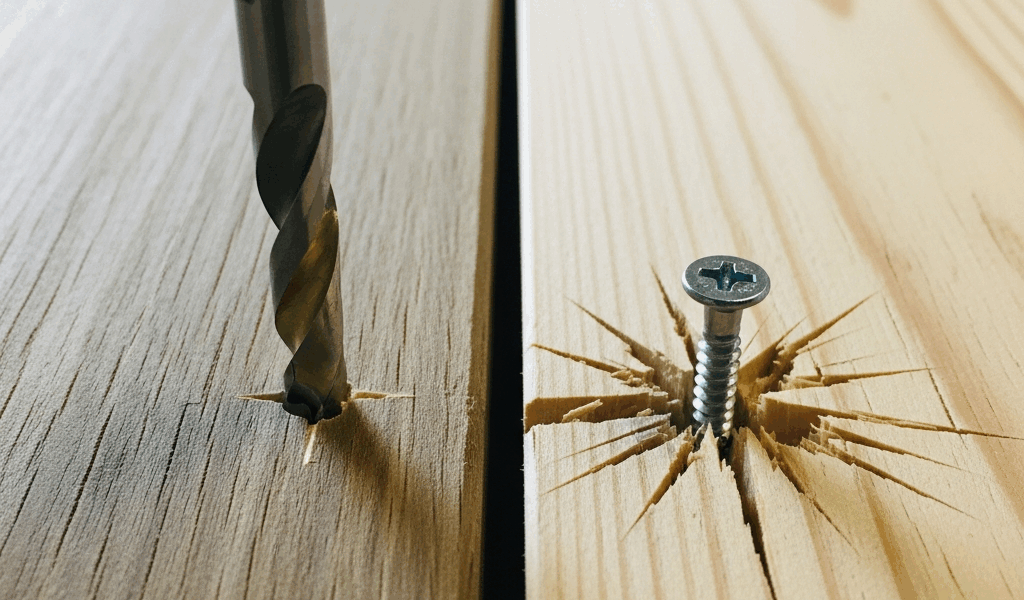
Why Wood Splits When You Drive Screws
As someone who’s spent the better part of eight years learning woodworking through a mix of YouTube tutorials and frankly expensive mistakes, I learned everything there is to know about wood splitting the hard way—by ruining several red oak tabletops before understanding what was actually happening.
Wood splits when you drive screws because the screw acts like a wedge, forcing wood fibers apart as it travels downward. Unlike nails, which crush fibers and push them aside, screws actually lift and separate the grain structure. This matters because wood isn’t uniform — it has grain direction, moisture content variation, and structural weak points that determine how easily it splits.
The grain direction is everything here. Driving screws along the grain (parallel to the wood fibers) is significantly safer than driving perpendicular to it. End grain—the exposed rings you see on the cut ends of boards—splits like nothing else. I once tried to screw directly into the end grain of a walnut board thinking I’d be fine. The wood exploded in a radial pattern from the screw hole. Painful learning experience.
Moisture content plays a huge role too. Wood shrinks and swells as it absorbs or loses water. Fresh lumber or wood with high moisture content is more pliable and splits less readily, while kiln-dried wood becomes brittle and prone to splitting. This is why your carefully seasoned hardwood boards are actually at higher risk than that wet construction lumber you might use for outdoor projects.
Different species split at different rates based on their cellular structure. Dense hardwoods like oak and walnut have tightly packed fibers that resist the initial penetration of a screw, then suddenly give way catastrophically. Softwoods like pine and spruce have more forgiving structures, but they still split if you’re careless with placement or screw size.
Pilot Holes vs. Pre-Drilling — Which One You Actually Need
Probably should have opened with this section, honestly. This is where most woodworkers get confused, and I blame manufacturers for poor terminology. A pilot hole and pre-drilling aren’t the same thing, though people use the terms interchangeably — they describe two totally different operations.
A pilot hole is a small, shallow hole that guides your screw and reduces the splitting risk slightly. You drill it to about 50% of the screw’s diameter and depth. Pre-drilling, by contrast, means drilling a hole large enough that the screw’s threads don’t actually bite into the wood — they pass through in an unthreaded shank. The distinction matters because it determines whether you get pulling power or just a fastener sitting loose.
Here’s the decision tree I actually use:
- Softwood + thin screw (#4 or #6) = pilot hole only (1/16″ diameter)
- Softwood + thick screw (#10 or larger) = full pre-drill with countersink
- Hardwood + thin screw = pilot hole (1/8″ diameter, slightly larger than softwood)
- Hardwood + thick screw = full pre-drill plus pilot hole for the shank
- End grain, any situation = full pre-drill plus pilot
For pilot holes, I use a bit that’s roughly 80–90% of the screw’s root diameter (the narrowest part where threads meet the shank). A #8 wood screw, for example, has a root diameter of about 0.164 inches, so I’d use a 5/32″ bit (0.156″) for softwood and a 9/64″ bit for hardwood. Getting this exact isn’t critical — being within 1/64″ is fine.
When you’re pre-drilling, use a bit matching the screw’s shank diameter (the smooth part above the threads). That same #8 screw has a shank diameter of about 0.190 inches, so a 3/16″ bit works perfectly. Then you need a separate pilot hole below that, which is where most people get lost and just eyeball it. Don’t eyeball it. Use that 5/32″ or 9/64″ bit for the actual pilot portion below the pre-drilled shank hole.
I keep a simple laminated chart taped inside my shop cabinet with the common screw sizes and their corresponding bit sizes. Cost me $2 to print. Saved me hundreds in ruined stock.
Screw Selection and Placement Techniques That Stop Splits
Frustrated by ruined walnut after splitting three consecutive pieces, I experimented using different screw types to understand which designs resist splitting. The difference is real and immediate.
Coarse-threaded wood screws have wider thread spacing and deeper threads, which means they grab wood fibers more aggressively. Fine-threaded screws (cabinet screws, often) have gentler threads that bite gradually. For splitting prevention, fine-threaded screws are objectively better — especially in hardwoods and near edges. They cost about 30% more per unit, but they’re worth it for critical joints. I use Spax or Torx cabinet screws for 90% of my hardwood work now.
Screw placement is equally important. The golden rule is keeping screws at least 1 inch from the edge of any board. I actually use 1.5 inches as my standard now after splitting a cherry board that I thought was safely recessed. For end grain, move that distance to 2 inches minimum and always pre-drill with a full shank hole, not just a pilot.
Countersinking versus counterboring changes the splitting dynamic. When you countersink (creating a conical recess), the screw enters at an angle from the top, which concentrates stress. Counterboring (a flat-bottomed hole) lets the screw descend straight down, distributing stress more evenly. For split-prone situations, counterbore instead of countersink.
Thread the screws in slowly. I use my drill on the slowest setting for the last few turns — around 300 RPM. Fast insertion generates heat, which can expand the wood slightly and increase splitting risk. Patience here pays literal dividends.
Quick Fixes When You Don’t Have the Right Tools
Real talk: not everyone has a complete brad point bit set or access to cabinet screws. I didn’t for my first three years.
A finish nail works as an emergency pilot hole maker. Snip off about 2 inches of the nail with wire cutters, chuck it in your drill, and use it to create a starter hole at 1/4 the speed of a proper bit. It’s not elegant, but it works. I’ve done this on job sites dozens of times.
Soap or beeswax on the screw threads reduces friction dramatically. Just rub the screw on a bar of Fels-Naptha soap or a beeswax block before driving it. This isn’t old wives’ tale stuff — it genuinely works by creating a lubricant layer that reduces the wedging force. I do this automatically for any hardwood screw work.
If you lack proper pre-drilling bits, a standard twist drill at 80–90% of the screw diameter works. It’s not as clean as a brad point bit, but the wood fibers get separated rather than crushed, which is what matters for splitting prevention.
Species-Specific Tips for Walnut, Oak, and Softwoods
Walnut splits like temperamental glass if you mishandle screw placement. The wood is dense, beautiful, and absolutely unforgiving. Always pre-drill with a full shank hole for any screw larger than #6. Use fine-threaded cabinet screws whenever possible. Walnut’s color is rich enough to hide counterbores, so I counterbore instead of countersink. Keep screws 1.5 inches minimum from edges, and avoid end grain entirely — unless pre-drilled and countered.
Red oak splits readily because of its open grain structure and the way its fibers separate. Standard wood screws with coarse threads are particularly problematic here. I use fine-threaded screws exclusively and always pilot-hole, even for smaller screws. The good news is oak’s lighter color makes visible counterbores acceptable, and the grain pattern hides slight imperfections.
Softwoods like pine and spruce are forgiving but not invincible. A #10 screw into pine without any pilot hole might work nine times out of ten, but that tenth time, you’ll split the board and question your entire approach. Pilot holes cost seconds and prevent 100% of the regrettable outcomes. For softwoods, a simple 1/16″ pilot hole is usually sufficient — even for larger screws.


Stay in the loop
Get the latest craftsman charm updates delivered to your inbox.