Quarter-Sawn vs Flat-Sawn White Oak — Which Cut for Craftsman Furniture?
The quarter sawn vs flat sawn oak question sounds like a technical lumber debate. It isn’t. It’s a question about whether your Craftsman furniture looks like the real thing or a reasonable facsimile. I built my first Mission-style side table from flat-sawn white oak I grabbed at a big box store, and it looked fine — clean grain, good color, solid construction. But when I set it next to a genuine Stickley piece at an antique dealer’s shop, I immediately understood what was missing. The flat-sawn board looked plain. Almost anonymous. The Stickley piece had this shimmering, almost metallic fleck running across the surface. That fleck isn’t decorative. It’s structural. And you cannot get it from flat-sawn lumber, period.
What Makes Quarter-Sawn Oak Look Different
White oak has medullary rays — ribbon-like cellular structures that radiate outward from the center of the tree like spokes on a wheel, perpendicular to the growth rings. In a living tree, these rays transport nutrients horizontally across the trunk. When you mill the log, the angle of the cut determines whether those rays appear on the face of the board or disappear into it.
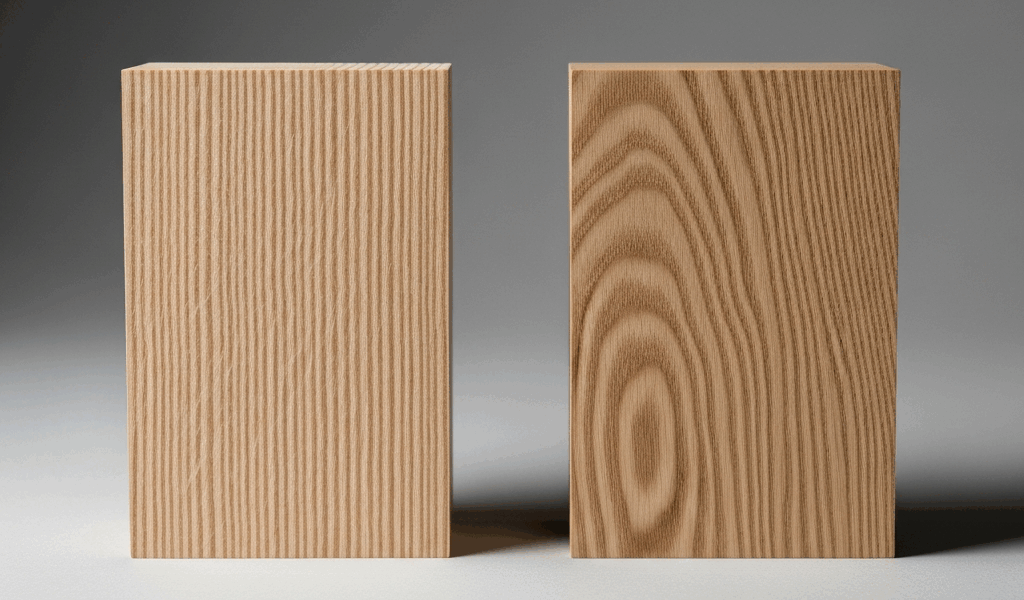
Quarter-sawing cuts the log in radial slices — roughly perpendicular to the growth rings. That geometry brings the medullary rays face-up on the board’s surface, where they show as broad, silvery or copper-toned flecks. Depending on the angle of the cut and the specific log, the fleck pattern ranges from subtle shimmer to dramatic wide ribbons that catch light differently as you move around the piece. Some people call it ray fleck. Some call it silver fleck or figure. Whatever you call it, it’s unmistakable once you’ve seen it.
Flat-sawing cuts through the log tangentially — the classic method that produces the most usable lumber from a given log. The growth rings run nearly parallel to the face, producing the arched cathedral grain pattern most people associate with generic oak. The medullary rays are still in the wood. They run perpendicular to the face, down into the board, completely invisible. You get cathedral grain and occasional straight grain near the center of the log. No fleck. None.
This isn’t a subtle visual difference. Side by side, quarter-sawn and flat-sawn white oak look like different species to an untrained eye. That matters enormously if you’re building Craftsman furniture and you want it to read correctly.
Why Craftsman Furniture Uses Quarter-Sawn
Probably should have opened with this section, honestly, because it’s the whole reason the technical distinction matters for furniture makers.
The Arts and Crafts movement in America — roughly 1880 through 1920 — was a direct reaction against machine-made Victorian excess. The guiding philosophy was honest materials, honest construction, nothing hidden or fake. Gustav Stickley, who built his Craftsman Workshops in Syracuse, New York, specified quarter-sawn white oak for nearly every visible surface he produced. Charles Limbert out of Grand Rapids did the same. So did Roycroft, L. and J.G. Stickley, and the rest of the serious makers of the period.
This wasn’t arbitrary. The ray fleck pattern was understood as the wood’s own natural structure made visible — the tree revealing its honest internal architecture. Using quarter-sawn oak was a philosophical statement aligned with everything the movement stood for. It was the wood showing you exactly what it was.
Drawn by the appeal of Craftsman furniture, a lot of modern woodworkers build accurate reproductions using careful joinery, mortise-and-tenon construction, and appropriate hardware — then reach for flat-sawn oak at the lumber yard because it’s cheaper and easier to find. The proportions are right. The joinery is right. But the piece reads as vaguely Mission-adjacent rather than definitively Craftsman. The fleck is the visual signature. Without it, you’re building something that rhymes with the style rather than speaks it.
Technical Differences Beyond Appearance
Quarter-sawn oak isn’t just prettier for Craftsman work. It’s better wood for furniture in a measurable, practical sense.
Wood expands and contracts with seasonal humidity changes across the grain, not along it. In a flat-sawn board, the growth rings run roughly parallel to the face, which means the width of the board is where most movement happens. A 12-inch flat-sawn white oak panel might move 5/16 inch or more between a humid summer and a dry heated winter interior.
In a quarter-sawn board, the growth rings run through the thickness of the board rather than across the width. Movement still happens, but it happens through the thickness — where it’s constrained by your joinery — rather than across the width, where it wants to cup and warp. Quarter-sawn white oak is meaningfully more stable. Less cupping. Less warping. Tabletops stay flat longer.
The tradeoff is cost and availability. Quarter-sawing a log produces more waste than flat-sawing. The cuts are less efficient. Expect to pay a 20 to 40 percent premium over comparable flat-sawn white oak, and that’s when you can find it. Which brings up the next problem.
Finding Quarter-Sawn White Oak
Home Depot does not stock quarter-sawn white oak. Neither does Lowe’s. Neither does most regional lumber chains. This is specialty hardwood dealer territory, and if you haven’t bought from one before, the experience is different — boards sold by the board foot, often in random widths and lengths, stored in stickered stacks you walk through yourself.
Local hardwood dealers are the first call. If you’re near a metro area, there’s likely a dealer within an hour. Woodcraft retail locations carry quarter-sawn white oak fairly reliably and sell in smaller quantities, which is useful if you’re building one piece rather than stocking a shop. For mail order, Bell Forest Products in Michigan and Capital Hardwoods both ship quality quarter-sawn white oak, though shipping cost on heavy hardwood lumber adds up fast.
When you’re buying, look at the face of the board. Quarter-sawn shows the fleck pattern clearly — broad silvery patches, sometimes running in loose parallel bands. If you don’t see fleck, you’re looking at flat-sawn or rift-sawn stock. Rift-sawn falls between the two: cut at roughly 45 degrees to the growth rings, it shows straight consistent grain without much fleck, and it’s actually ideal for chair legs and other linear elements where straight grain reads well.
Ask the dealer explicitly for quarter-sawn white oak. Some dealers stock rift-and-quartered mixed, which is fine for most applications. Expect to pay somewhere between $8 and $14 per board foot depending on your region and the current market — I paid $10.50 per board foot last fall at a dealer in central Ohio for 8/4 stock, which is typical for the region.
When Flat-Sawn Oak Is Fine
Flat-sawn oak is not inferior wood. It’s the right choice in specific situations, and using quarter-sawn everywhere is overkill that costs real money for no real gain.
Painted surfaces. Full stop. If you’re building Craftsman trim work, painted built-ins, or any surface that takes a solid opaque finish, flat-sawn oak works perfectly. The grain pattern is irrelevant. Save the quarter-sawn stock for stained or natural-finish surfaces where the fleck does its work.
Hidden structural components — drawer sides, secondary framing, interior cabinet parts — don’t need quarter-sawn. Use flat-sawn, save the money, put better wood on the door fronts and tabletop where people actually look.
Budget reproductions where the goal is approximate rather than authentic Craftsman style can use flat-sawn throughout. The piece won’t read as Craftsman to anyone who knows the furniture, but it’ll be structurally sound and look like oak furniture.
The simple rule: quarter-sawn white oak on every visible, naturally finished surface of Craftsman furniture. Flat-sawn for everything that gets painted or stays hidden. The fleck pattern is part of the design. It was always part of the design — Stickley understood that a hundred years ago, and the furniture he built still makes the case every time you look at it.



Stay in the loop
Get the latest craftsman charm updates delivered to your inbox.